lunes, 30 de mayo de 2016

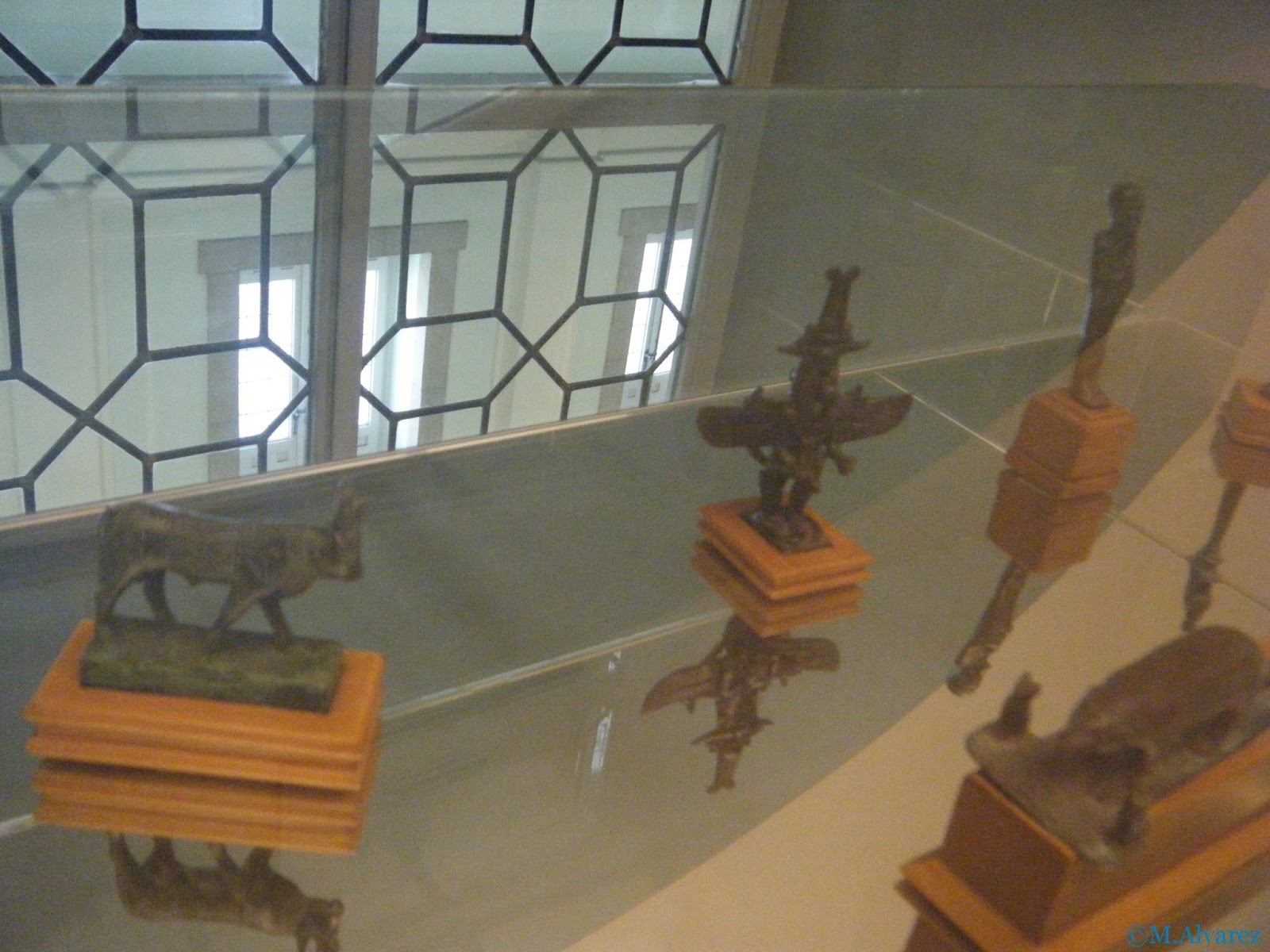
Objetos egipcios. Museo de Bellas artes de Madrid


 Objetos egipcios. Museo de Bellas artes de Madrid


martes, 24 de mayo de 2016

Female figure with raised arms

Female figure with raised arms

Female figurines of this type, made from Nile silt, are among the oldest sculptures in Egyptian art. Their form is extremely schematised, and their heads tend to resemble that of a bird. The arms are raised beside the head with the palms of the hands turned to face inward, and the upper part of the body leans forward slightly. At the bottom of the legs is the hint of a foot. Their function in a tomb is not immediately apparent; are they bird-headed deities, fertility goddesses, concubines for the deceased, mourners, or even dancers?

Present location KMKG - MRAH [07/003] BRUSSELS
Inventory number E.3006
Dating NAQADA II
Archaeological Site UNKNOWN
Category HUMAN FIGURINE
Material SILTSTONE
Technique FORMED BY HAND; PAINTED
Height 23.7 cm
Width 15.1 cm


Bibliography•F. Lefebvre et B. Van Rinsveld, L'Égypte. Des Pharaons aux Coptes, Bruxelles 1990, 20
•S. Hendrickx, Prehistorische en vroegdynastische oudheden uit Egypte - Antiquités préhistoriques et protodynastiques d'Égypte, Bruxelles 1994, 26-27


globalegyptianmuseum

miércoles, 18 de mayo de 2016

palacio de Cnosos. Creta

palacio de Cnosos.
Creta


miércoles, 11 de mayo de 2016

Museo de las Culturas del Mundo. Barcelona


Máscara Ekpo para conmemorar a los difuntos y para las ceremonias agrarias.
Ogoni -Nigeria
Primera mitad del siglo XX
...
Museo de las Culturas del Mundo.
Barcelona


Figura guardiana pangulubalang
piedra calcárea
Batak, Toba Batak.
...
Norte de Sumatra
Siglo XIX o anterior
Museo de las Culturas del Mundo.
Barcelona


Buda
bronce
Norte de Tailandia
...
Siglo XIV
Museo de las Culturas del Mundo.
Barcelona


-Máscara de teatro no (ko-omate)
Japón
siglos XVII-XVIII
...
madera pintada
-Máscara de teatro no (rojo)
segunda mitad del siglo XVI
madera pintada
Museo de las Culturas del Mundo.
Barcelona


sábado, 30 de abril de 2016

Collares

These four strands of beads come from the so-called Great Death Pit, one of the royal graves at Ur. The sixty-eight female bodies discovered in the pit were all adorned with the most splendid jewelry made of gold, lapis lazuli, and carnelian.

When excavated at Ur, beads were rarely discovered in an undisturbed state, since they had been originally strung together using organic material that has long since disintegrated. Thus, it is not certain in which order the beads were originally strung. These strands consist of biconical shaped beads. They are strung in groups of three gold sheets and six lapis lazuli beads, ending with one of gold and three of lapis. Their repetition gives a sense of rich contrasting color within the highly uniform Sumerian artistic system. It is possible that the different materials held particular meanings, since later texts describe their amuletic and magical properties. They certainly evoked distant lands because none of them are native to southern Mesopotamia and indicate the importance of long-distance connections in the acquisition of precious materials. The lapis lazuli would have originated in the Badakhshan region of Afghanistan and the gold reached Mesopotamia from a number of possible directions since there were ancient sources in Iran, Anatolia, and even as far away as Egypt.


 Period:Early Dynastic IIIaDate:ca. 2600–2500 B.C.Geography:Mesopotamia, Ur (modern Tell al-Muqayyar)Culture:SumerianMedium:Gold, lapis lazuliDimensions:L. 54 cm

Met Museum.
metmuseum.org

viernes, 18 de marzo de 2016

Base d'une dédicace, en marbre, trouvée sur l'agora d'Athènes

Base d'une dédicace, en marbre, trouvée sur l'agora d'Athènes. Base d'une dédicace pour des victoires dans un concours de bataille de cavalerie (anthippasia). Trois côtés de la base portent des bas-reliefs représentant un cavalier se dirigeant vers un tripode. L'inscription sur le quatrième côté donne le nom des dédicants victorieux et aussi celui du sculpteur, Bryaxis, auteur du monument. La base supportait le tripode de bronze dédié aux vainqueurs. Milieu du IVe s. av. J.-C.
Museo Arqueológico Nacional de Atenas

martes, 8 de marzo de 2016

Antiquitatis Extra Fines Hungariae Reperta. Vol. IV by Laszlo Torok

Antiquitatis Extra Fines Hungariae Reperta. Vol. IV
by Laszlo Torok
English summary: The catalogue of all the Egyptian terracotta objects of the Hellenistic and Roman periods in the Museum of Fine Arts, Budapest. The presentation of the individual pieces includes a full discussion of their relative chronology and their iconography. Since the material is mostly of unknown provenance, it has been possible to propose a dating almost exclusively on the basis of careful stylistic analysis. Italian description: La catalogazione di tutti gli oggetti in terracotta egiziani di epoca ellenistica e romana conservati nel Museum of Fine Arts di Budapest. La presentazione dei singoli pezzi comprende unampia discussione sulla loro cronologia relativa e sulla loro iconografia. Trattandosi infatti per la maggior parte di materiale di cui non si conosce la provenienza, e stato possibile proporre una datazione quasi esclusivamente sulla base di unaccurata analisi stilistica.